Coroutines, Scheduler, and Reactor
Scheduler and Reactor are the two main components of the runtime. Scheduler manages the coroutine queue and context switching, while Reactor handles I/O events through the Event loop.
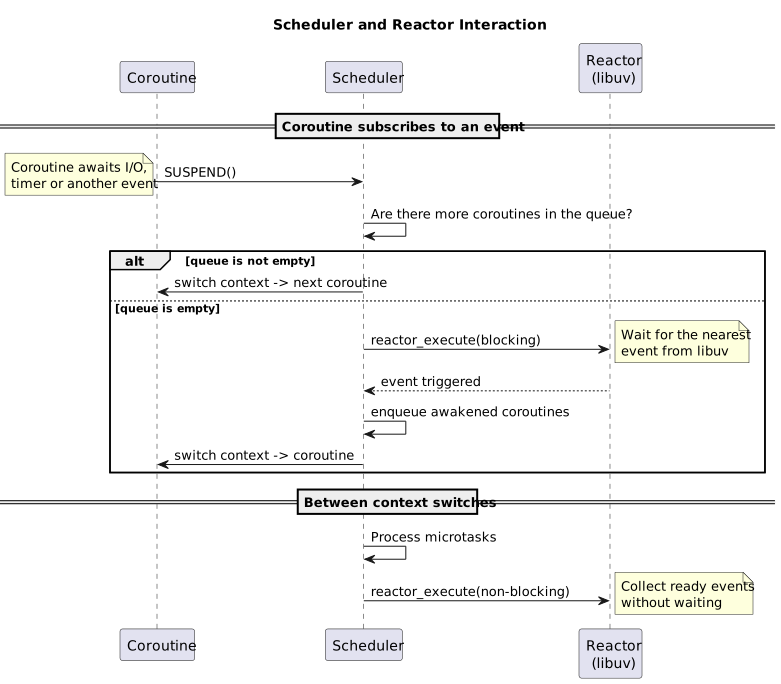
Scheduler
Scheduler Coroutine and Minimizing Context Switches
In many coroutine implementations, the scheduler uses a separate thread or at least a separate execution context. A coroutine calls yield, control passes to the scheduler, which picks the next coroutine and switches to it. This results in two context switches per suspend/resume: coroutine -> scheduler -> coroutine.
In TrueAsync, the Scheduler has its own coroutine (ZEND_ASYNC_SCHEDULER) with a dedicated context. When all user coroutines are sleeping and the queue is empty, control is passed to this coroutine, where the main loop runs: reactor tick, microtasks.
Because coroutines use a full execution context (stack + registers), context switching takes roughly 10-20 ns on modern x86. Therefore, TrueAsync optimizes the number of switches by allowing some operations to execute directly in the current coroutine's context, without switching to the scheduler.
When a coroutine calls a SUSPEND() operation, scheduler_next_tick() is called directly in the current coroutine's context -- a function that performs one scheduler tick: microtasks, reactor, queue check. If there is a ready coroutine in the queue, the Scheduler switches to it directly, bypassing its own coroutine. This is one context switch instead of two. Moreover, if the next coroutine in the queue hasn't started yet and the current one has already finished, no switch is needed at all -- the new coroutine receives the current context.
Switching to the Scheduler coroutine (via switch_to_scheduler()) occurs only if:
- The coroutine queue is empty and the reactor needs to wait for events
- Switching to another coroutine failed
- A deadlock is detected
Main Loop
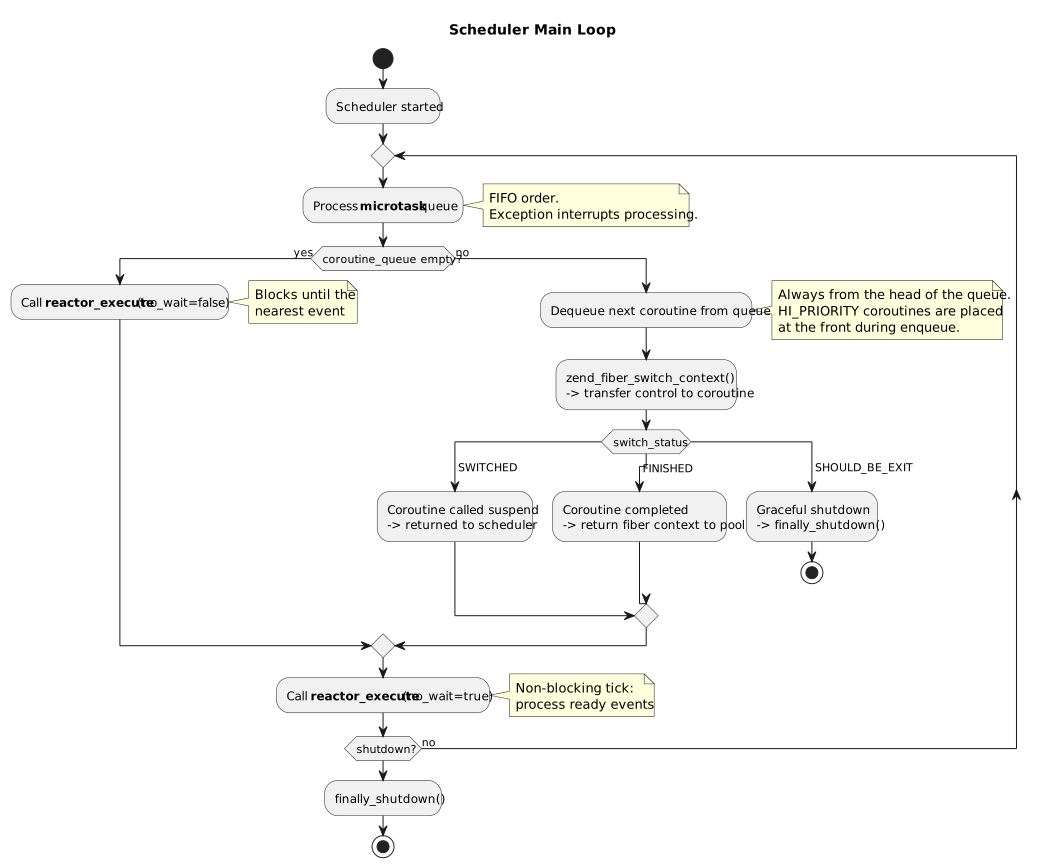
On each tick, the scheduler performs:
- Microtasks -- processing the
microtasksqueue (small tasks without context switching) - Coroutine queue -- extracting the next coroutine from the
coroutine_queue - Context switching --
zend_fiber_switch_context()to the selected coroutine - Result handling -- checking the coroutine's status after return
- Reactor -- if the queue is empty, calling
ZEND_ASYNC_REACTOR_EXECUTE(no_wait)
Microtasks
Not every action deserves a coroutine. Sometimes you need to do something quick between switches: update a counter, send a notification, release a resource. Creating a coroutine for this is excessive, yet the action needs to be performed as soon as possible. This is where microtasks come in handy -- lightweight handlers that execute directly in the current coroutine's context, without switching.
Microtasks must be lightweight, fast handlers since they get direct access to the scheduler's loop. In early versions of TrueAsync, microtasks could reside in PHP-land, but due to strict rules and performance considerations, the decision was made to keep this mechanism for C code only.
struct _zend_async_microtask_s {
    zend_async_microtask_handler_t handler;
    zend_async_microtask_handler_t dtor;
    bool is_cancelled;
    uint32_t ref_count;
};
In TrueAsync, microtasks are processed via a FIFO queue before each coroutine switch. If a microtask throws an exception, processing is interrupted. After execution, the microtask is immediately removed from the queue, and its active reference count is decremented by one.
Microtasks are used in scenarios such as the concurrent iterator, allowing iteration to automatically transfer to another coroutine if the previous one entered a waiting state.
Coroutine Priorities
Under the hood, TrueAsync uses the simplest type of queue: a circular buffer. This is probably the best solution in terms of the balance between simplicity, performance, and functionality.
There is no guarantee that the queue algorithm won't change in the future. That said, there are rare occasions when coroutine priority matters.
Currently, two priorities are used:
typedef enum {
    ZEND_COROUTINE_NORMAL = 0,
    ZEND_COROUTINE_HI_PRIORITY = 255
} zend_coroutine_priority;
High-priority coroutines are placed at the head of the queue during enqueue. Extraction always happens from the head. No complex scheduling, just insertion order. This is a deliberate simple approach: two levels cover real-world needs, while complex priority queues (as in RTOS) would add overhead unjustified in the context of PHP applications.
Suspend and Resume
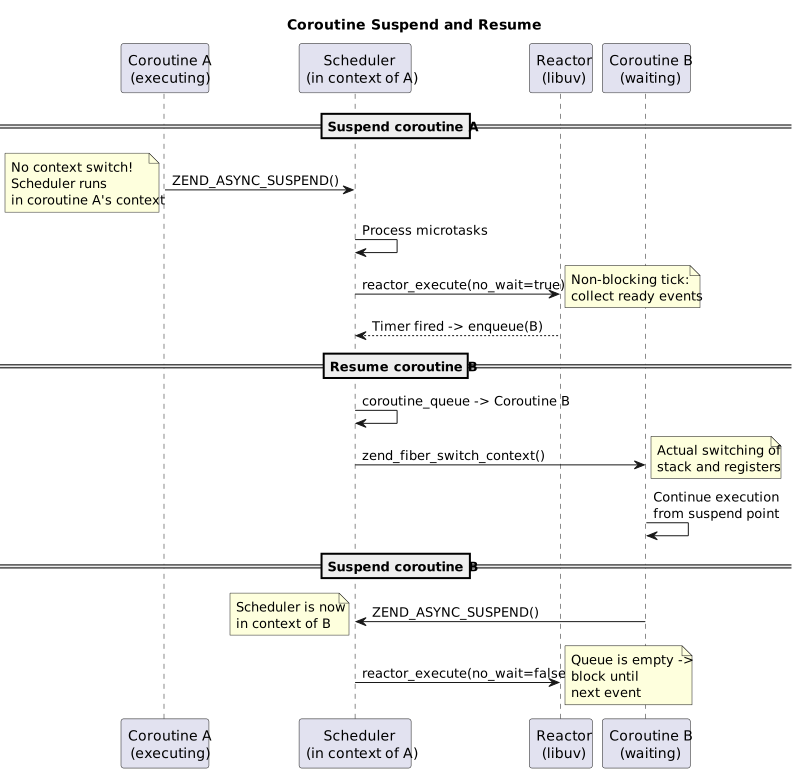
Suspend and Resume operations are the core tasks of the Scheduler.
When a coroutine calls suspend, the following happens:
- The coroutine's
wakerevents are started (start_waker_events). Only at this moment do timers begin ticking and poll objects start listening on descriptors. Before callingsuspend, events are not active -- this allows preparing all subscriptions first, then starting the wait with a single call. - Without a context switch,
scheduler_next_tick()is called:- Microtasks are processed
- A
reactor tickis performed (if enough time has passed) - If there is a ready coroutine in the queue,
execute_next_coroutine()switches to it - If the queue is empty,
switch_to_scheduler()switches to theschedulercoroutine
- When control returns, the coroutine wakes up with the
wakerobject that holds thesuspendresult.
Fast return path: if during start_waker_events an event has already fired (e.g., a Future is already completed), the coroutine is not suspended at all -- the result is available immediately. Therefore, await on a completed Future does not trigger suspend and does not cause a context switch, returning the result directly.
Context Pool
A context is a full C stack (EG(fiber_stack_size) by default). Since stack creation is an expensive operation, TrueAsync strives to optimize memory management. We account for the memory usage pattern: coroutines are constantly dying and being created. The pool pattern is ideal for this scenario!
struct _async_fiber_context_s {
    zend_fiber_context context;     // Native C fiber (stack + registers)
    zend_vm_stack vm_stack;         // Zend VM stack
    zend_execute_data *execute_data;// Current execute_data
    uint8_t flags;                  // Fiber state
};
Instead of constantly creating and destroying memory, the Scheduler returns contexts to the pool and reuses them over and over.
The pool size follows the load. A minimum of 4 contexts is always kept. When a coroutine finishes and the pool holds fewer contexts than there are coroutines waiting in the queue, its context is returned to the pool; otherwise the context is destroyed. So the pool grows under pressure and shrinks back when the queue drains, which bounds both mmap/mprotect latency and memory footprint.
Switch Handlers
In PHP, many subsystems rely on a simple assumption: code executes from start to finish without interruption. The output buffer (ob_start), object destructors, global variables -- all of this works linearly: start -> end.
Coroutines break this model. A coroutine can sleep in the middle of its work and wake up after thousands of other operations. Between LEAVE and ENTER on the same thread, dozens of other coroutines will have run.
Switch Handlers are hooks bound to a specific coroutine. Unlike microtasks (which fire on any switch), a switch handler is called only on enter and exit of "its" coroutine:
typedef bool (*zend_coroutine_switch_handler_fn)(
    zend_coroutine_t *coroutine,
    bool is_enter,    // true = enter, false = exit
    bool is_finishing // true = coroutine is finishing
    // return: true = keep handler, false = remove
);
The return value controls the handler's lifetime:
true-- thehandlerstays and will be called again.false-- theSchedulerwill remove it.
The Scheduler calls handlers at three points:
ZEND_COROUTINE_ENTER(coroutine)  // Coroutine received control
ZEND_COROUTINE_LEAVE(coroutine)  // Coroutine yielded control (suspend)
ZEND_COROUTINE_FINISH(coroutine) // Coroutine is finishing permanently
Example: Output Buffer
The ob_start() function uses a single handler stack. When a coroutine calls ob_start() and then goes to sleep, another coroutine may see the other's buffer if nothing is done. (By the way, Fiber does not handle ob_start() properly.)
A one-shot switch handler solves this at coroutine startup: it moves the global OG(handlers) into the coroutine's context and clears the global state. After this, each coroutine works with its own buffer, and echo in one doesn't mix with another.
Example: Destructors During Shutdown
When PHP shuts down, zend_objects_store_call_destructors() is called -- traversing the object store and calling destructors. Normally this is a linear process.
But a destructor may contain await. For example, a database connection object wants to properly close the connection -- which is a network operation. The coroutine calls await inside the destructor and goes to sleep.
The remaining destructors need to continue. The switch handler catches the LEAVE moment and spawns a new high-priority coroutine that continues the traversal from the object where the previous one stopped.
Registration
// Add handler to a specific coroutine
ZEND_COROUTINE_ADD_SWITCH_HANDLER(coroutine, handler);

// Add to the current coroutine (or to main if Scheduler hasn't started yet)
ZEND_ASYNC_ADD_SWITCH_HANDLER(handler);

// Add handler that fires when the main coroutine starts
ZEND_ASYNC_ADD_MAIN_COROUTINE_START_HANDLER(handler);
The last macro is needed by subsystems that initialize before the Scheduler starts. They register a handler globally, and when the Scheduler creates the main coroutine, all global handlers are copied into it and fire as ENTER.
Reactor
Why libuv?
TrueAsync uses libuv, the same library that powers Node.js.
The choice is deliberate. libuv provides:
- A unified
APIforLinux(epoll), macOS (kqueue), Windows (IOCP) - Built-in support for timers, signals,
DNS, child processes, file I/O - A mature codebase tested by billions of requests in production
Alternatives (libev, libevent, io_uring) were considered, but libuv wins on usability.
Structure
// Reactor global data (in ASYNC_G)
uv_loop_t uvloop;
bool reactor_started;
uint64_t last_reactor_tick;

// Signal management
HashTable *signal_handlers;  // signum -> uv_signal_t*
HashTable *signal_events;    // signum -> HashTable* (events)
HashTable *process_events;   // SIGCHLD process events
Event Types and Wrappers
Each event in TrueAsync has a dual nature: an ABI structure defined in the PHP core, and a libuv handle that actually interacts with the OS. The Reactor "glues" them together, creating wrappers where both worlds coexist:
| Event Type | ABI Structure | libuv handle |
|---|---|---|
| Poll (fd/socket) | zend_async_poll_event_t | uv_poll_t |
| Timer | zend_async_timer_event_t | uv_timer_t |
| Signal | zend_async_signal_event_t | Global uv_signal_t |
| Filesystem | zend_async_filesystem_event_t | uv_fs_event_t |
| DNS | zend_async_dns_addrinfo_t | uv_getaddrinfo_t |
| Process | zend_async_process_event_t | HANDLE (Win) / waitpid |
| Thread | zend_async_thread_event_t | uv_thread_t |
| Exec | zend_async_exec_event_t | uv_process_t + uv_pipe_t |
| Trigger | zend_async_trigger_event_t | uv_async_t |
For more details on event structure, see Events and the Event Model.
Async IO
For stream operations, a unified async_io_t is used:
struct _async_io_t {
    zend_async_io_t base;   // ABI: event + fd/socket + type + state
    int crt_fd;             // CRT file descriptor
    async_io_req_t *active_req;
    union {
        uv_stream_t stream;
        uv_pipe_t pipe;
        uv_tty_t tty;
        uv_tcp_t tcp;
        uv_udp_t udp;
        struct { zend_off_t offset; } file;
    } handle;
};
The same interface (ZEND_ASYNC_IO_READ/WRITE/CLOSE) works with PIPE, FILE, TCP, UDP, TTY. The specific implementation is selected at handle creation time based on type.
Reactor Loop
reactor_execute(no_wait) calls one tick of the libuv event loop:
no_wait = true-- non-blocking call, process only ready eventsno_wait = false-- block until the next event
The Scheduler uses both modes. Between coroutine switches -- a non-blocking tick to collect events that have already fired. When the coroutine queue is empty -- a blocking call to avoid wasting CPU in an idle loop.
This is a classic strategy from the world of event-driven servers: nginx, Node.js, and Tokio use the same principle: poll without waiting while there's work to do, and sleep when there's no work.
Switching Efficiency: TrueAsync in the Industry Context
Stackful vs Stackless: Two Worlds
There are two fundamentally different approaches to implementing coroutines:
Stackful (Go, Erlang, Java Loom, PHP Fibers) -- each coroutine has its own C stack. Switching involves saving/restoring registers and the stack pointer. The main advantage: transparency. Any function at any call depth can invoke suspend without requiring special annotations. The programmer writes ordinary synchronous code.
Stackless (Rust async/await, Kotlin, C# async) -- the compiler transforms an async function into a state machine. "Suspending" is just a return from the function, and "resuming" is a method call with a new state number. The stack is not switched at all. The cost: "function coloring" (async infects the entire call chain).
| Property | Stackful | Stackless |
|---|---|---|
| Suspension from nested calls | Yes | No -- only from async functions |
| Switching cost | 15-200 ns (register save) | 10-50 ns (writing fields to object) |
| Memory per coroutine | 4-64 KiB (separate stack) | Exact state machine size |
| Compiler optimization through yield | Not possible (stack is opaque) | Possible (inline, HALO) |
PHP coroutines are stackful coroutines based on Boost.Context fcontext_t.
Architectural Trade-off
TrueAsync chooses the stackful single-threaded model:
- Stackful -- because the
PHPecosystem is huge, and "coloring" millions of lines of existing code withasyncis expensive. Stackful coroutines allow using regular C functions, which is a critical requirement for PHP. - Single-threaded -- PHP is historically single-threaded (no shared mutable state), and this property is easier to preserve than to deal with its consequences. Threads appear only in the
ThreadPoolforCPU-boundtasks.
Since TrueAsync currently reuses the low-level Fiber API, the context switching cost is relatively high and may be improved in the future.
Graceful Shutdown
A PHP script can terminate at any moment: an unhandled exception, exit(), an OS signal. But in the async world, dozens of coroutines may hold open connections, unwritten buffers, and uncommitted transactions.
TrueAsync handles this through a controlled shutdown:
ZEND_ASYNC_SHUTDOWN()->start_graceful_shutdown()-- sets the flag- All coroutines receive a
CancellationException - Coroutines get the opportunity to execute
finallyblocks -- close connections, flush buffers finally_shutdown()-- final cleanup of remaining coroutines and microtasks- The Reactor stops
#define TRY_HANDLE_EXCEPTION() \
    if (UNEXPECTED(EG(exception) != NULL)) { \
        if (ZEND_ASYNC_GRACEFUL_SHUTDOWN) { \
            finally_shutdown(); \
            break; \
        } \
        start_graceful_shutdown(); \
    }