Garbage Collection in Asynchronous Context
In PHP, the garbage collector normally works synchronously. When the possible roots buffer is full, gc_collect_cycles() is called in the current context. The GC computes circular references and calls object destructors in a loop for objects marked for deletion.
In a concurrent environment, this model breaks down. An object's destructor may call await -- for example, to properly close a database connection. If GC is running inside a coroutine, await will suspend that coroutine, leaving the GC in an incomplete state. Other coroutines will see partially collected objects.
For this reason, TrueAsync had to modify the garbage collection logic.
GC Coroutine
When the gc_possible_root buffer fills up and the threshold is triggered, zend_gc_collect_cycles() launches itself in a separate coroutine.
ZEND_API int zend_gc_collect_cycles(void)
{
    if (UNEXPECTED(ZEND_ASYNC_IS_ACTIVE
        && ZEND_ASYNC_CURRENT_COROUTINE != GC_G(gc_coroutine))) {

        if (GC_G(gc_coroutine)) {
            return 0;  // GC is already running in another coroutine
        }

        start_gc_in_coroutine();
        return 0;
    }

    // ... actual garbage collection
}
The coroutine that triggered GC is not blocked and continues its work, while garbage collection happens on the next Scheduler tick.
The GC coroutine gets its own top-level Scope (parent = NULL). This isolates garbage collection from user code: canceling a user Scope will not affect the GC.
Destructors in Coroutines
The main problem arises specifically when calling destructors, because destructors can unexpectedly suspend a coroutine. Therefore, the GC uses a concurrent iterator algorithm based on microtasks. To launch the iteration, GC creates yet another iterator coroutine. This is done to create the illusion of sequential execution, which simplifies the GC considerably.
static bool gc_call_destructors_in_coroutine(void)
{
    GC_G(dtor_idx) = GC_FIRST_ROOT;
    GC_G(dtor_end) = GC_G(first_unused);

    // Create child coroutine for destructors
    zend_coroutine_t *coroutine = gc_spawn_destructors_coroutine();

    // GC coroutine suspends on dtor_scope
    zend_async_resume_when(GC_G(gc_coroutine), &scope->event, ...);
    ZEND_ASYNC_SUSPEND();   // GC sleeps while destructors run

    return true;
}
The destructor uses the Scope mechanism not only to control the lifetime of coroutines, but also to await their completion. For this purpose, another child Scope is created to encapsulate all destructor coroutines:
gc_scope                          <- top-level `GC`
  \-- GC coroutine                <- marking + coordination
       \-- dtor_scope             <- child scope
            \-- dtor-coroutine[0] <- calling destructors (HI_PRIORITY)
The GC coroutine subscribes to the completion event of dtor_scope. It will wake up only when all destructors in dtor_scope have completed.
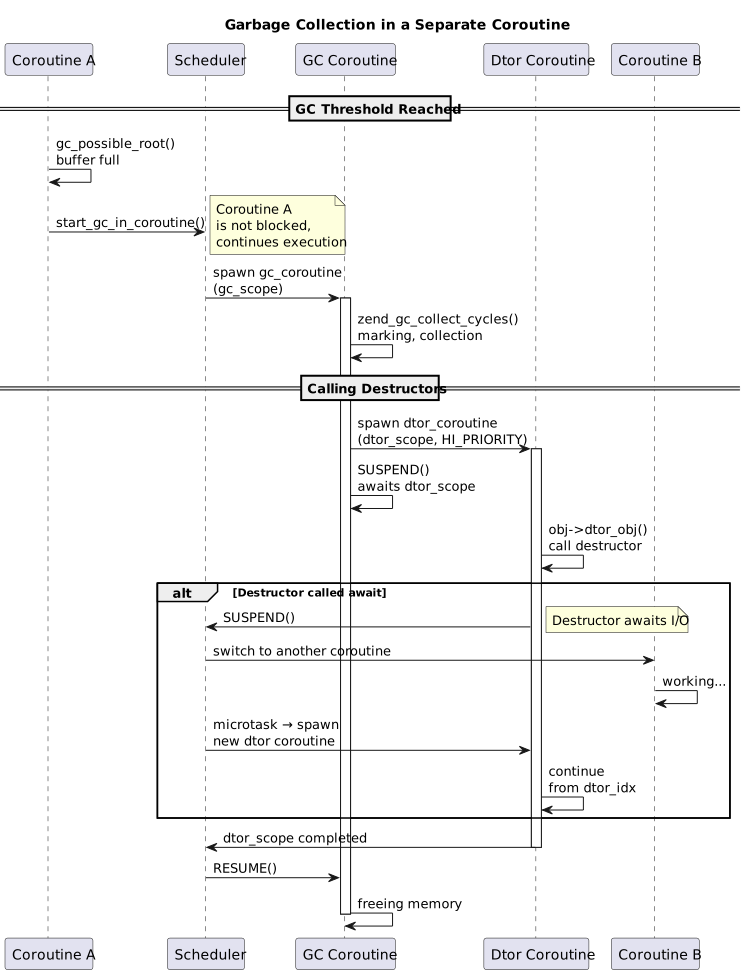
What If a Destructor Calls await?
Here the classic concurrent iterator algorithm based on microtasks is used:
- A microtask is registered that will execute if a context switch occurs
- If a switch happens, the microtask creates yet another coroutine for iteration
The iterator checks whether it is still in the same coroutine:
static zend_result gc_call_destructors(uint32_t idx, uint32_t end, ...)
{
    zend_coroutine_t *coroutine = ZEND_ASYNC_CURRENT_COROUTINE;

    while (idx != end) {
        obj->handlers->dtor_obj(obj);   // call destructor

        // If the coroutine changed -- the destructor called await
        if (coroutine != NULL && coroutine != *current_coroutine_ptr) {
            return FAILURE;   // abort traversal
        }
        idx++;
    }
    return SUCCESS;
}
If ZEND_ASYNC_CURRENT_COROUTINE has changed, it means the destructor called await and the current coroutine went to sleep. In this case, the iterator simply exits, and the next iteration step will be launched in a new coroutine.