TrueAsync + FrankenPHP: Many Requests, One Thread
In this article, we examine the experience of integrating FrankenPHP with TrueAsync. FrankenPHP is a server based on Caddy that runs PHP code inside a Go process. We added TrueAsync support to FrankenPHP, allowing each PHP thread to handle multiple requests simultaneously, using TrueAsync coroutines for orchestration.
How FrankenPHP Works
FrankenPHP is a process that bundles the Go world (Caddy) and PHP together. Go owns the process, while PHP acts as a "plugin" that Go interacts with through SAPI. To make this work, the PHP virtual machine runs in a separate thread. Go creates these threads and calls SAPI functions to execute PHP code.
For each request, Caddy creates a separate goroutine that handles the HTTP request. The goroutine selects a free PHP thread from the pool and sends the request data via a channel, then enters a waiting state.
When PHP finishes forming the response, the goroutine receives it via the channel and passes it back to Caddy.
We changed this approach so that goroutines now send multiple requests to the same PHP thread, and the PHP thread learns to handle such requests asynchronously.
General Architecture
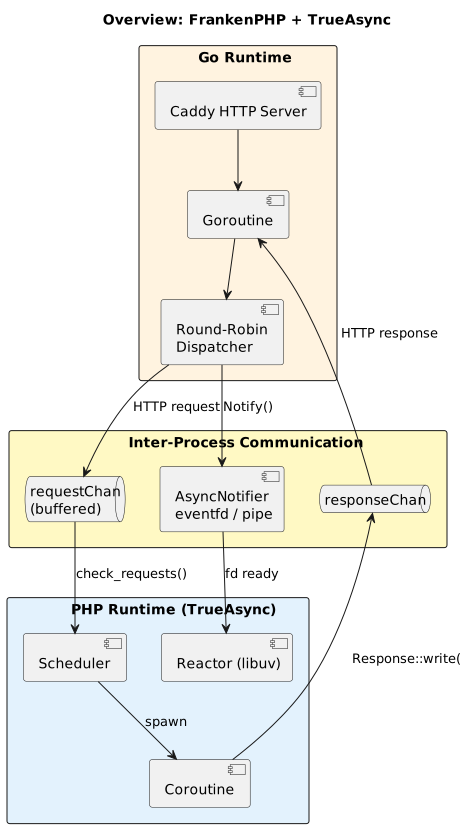
The diagram shows three layers. Let's examine each one.
Integrating Go into the TrueAsync Scheduler
For the application to work, the PHP Reactor and Scheduler must be integrated with Caddy. Therefore, we need some cross-thread communication mechanism that is compatible with both the Go and PHP worlds. Go channels are excellent for data transfer between threads and are accessible from C-Go. But they are not sufficient, since the EventLoop cycle may go to sleep.
There is an old well-known approach that can be found in almost any web server: a combination of a transfer channel and an fdevent (on macOS/Windows a pipe is used).
If the channel is not empty, PHP will be reading from it, so we just add another value. If the channel is empty, the PHP thread is sleeping and needs to be woken up. That's what Notify() is for.
func NewAsyncNotifier() (*AsyncNotifier, error) {
    if runtime.GOOS == "linux" {
        fd, err := createEventFD()  // eventfd -- the fastest option
        // ...
    }
    // Fallback: pipe for macOS/BSD
    syscall.Pipe(fds[:])
}
On the PHP side, the eventfd descriptor is registered in the Reactor:
request_event = ZEND_ASYNC_NEW_POLL_EVENT_EX(
    (zend_file_descriptor_t) notifier_fd,
    0, ASYNC_READABLE, sizeof(uintptr_t)
);
request_event->base.start(&request_event->base);
The Reactor (based on libuv) starts monitoring the descriptor. As soon as Go writes to eventfd, the Reactor wakes up and calls the request handling callback.
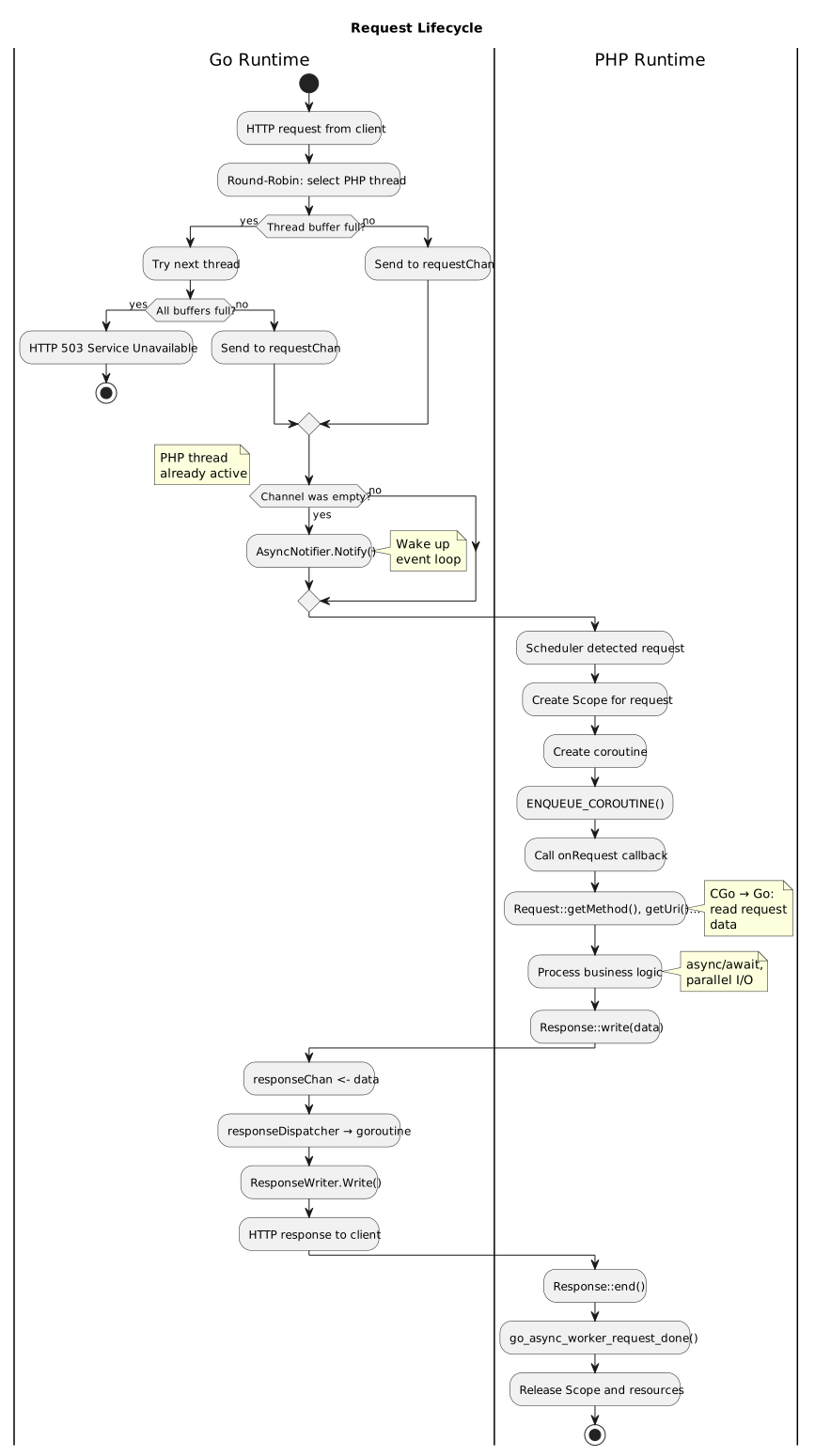
Now, when a goroutine packages request data into a contextHolder structure and passes it to the Dispatcher for delivery to the PHP thread. The Dispatcher cycles through PHP threads in round-robin fashion and attempts to send the request context to the buffered Go channel (requestChan) bound to a specific thread. If the buffer is full, the Dispatcher tries the next thread. If all are busy -- the client receives HTTP 503.
start := w.rrIndex.Add(1) % uint32(len(w.threads))
for i := 0; i < len(w.threads); i++ {
    idx := (start + uint32(i)) % uint32(len(w.threads))
    select {
    case thread.requestChan <- ch:
        if len(thread.requestChan) == 1 {
            thread.asyncNotifier.Notify()
        }
        return nil
    default:
        continue
    }
}
return ErrAllBuffersFull // HTTP 503
Integration with the Scheduler
When FrankenPHP initializes and creates PHP threads, it integrates with the Reactor/Scheduler using the True Async ABI (zend_async_API.h).
The frankenphp_enter_async_mode() function is responsible for this process and is called once when the PHP script registers a callback via HttpServer::onRequest():
void frankenphp_enter_async_mode(void)
{
    // 1. Get the notifier FD from Go
    notifier_fd = go_async_worker_get_notification_fd(thread_index);

    // 2. Register FD in the Reactor (slow path)
    frankenphp_register_request_notifier(notifier_fd, thread_index);

    // 3. Launch the Scheduler
    ZEND_ASYNC_SCHEDULER_LAUNCH();

    // 4. Replace the heartbeat handler (fast path)
    old_heartbeat_handler = zend_async_set_heartbeat_handler(
        frankenphp_scheudler_tick_handler
    );

    // 5. Suspend the main coroutine
    frankenphp_suspend_main_coroutine();

    // --- we only reach here on shutdown ---

    // 6. Restore the heartbeat handler
    zend_async_set_heartbeat_handler(old_heartbeat_handler);

    // 7. Release resources
    close_request_event();
}
We use a heartbeat handler, a special callback from the Scheduler, to add our own handler for each Scheduler tick. This handler allows FrankenPHP to create new coroutines for request processing.
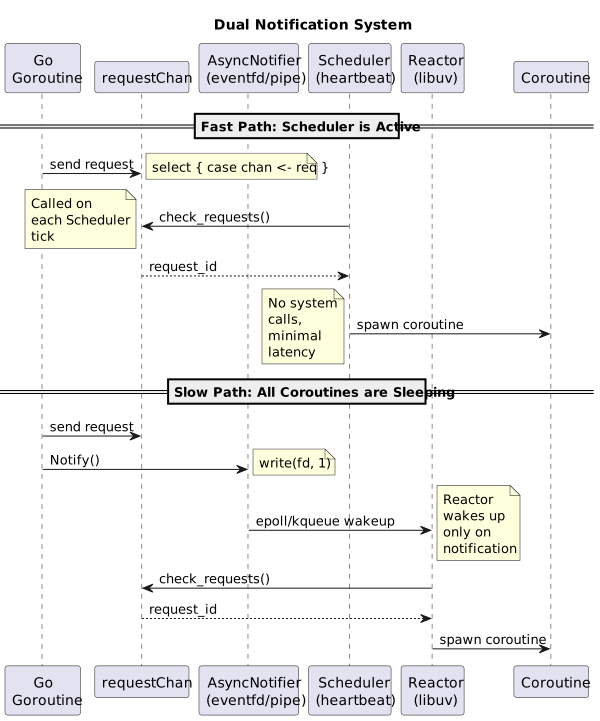
Now the Scheduler calls the heartbeat handler on each tick. This handler checks the Go channel via CGo:
void frankenphp_scheudler_tick_handler(void) {
    uint64_t request_id;
    while ((request_id = go_async_worker_check_requests(thread_index)) != 0) {
        if (request_id == UINT64_MAX) {
            ZEND_ASYNC_SHUTDOWN();
            return;
        }
        frankenphp_handle_request_async(request_id);
    }
    if (old_heartbeat_handler) old_heartbeat_handler();
}
No system calls, no epoll_wait, a direct call to a Go function via CGo. Instant return if the channel is empty. The cheapest possible operation, which is a mandatory requirement for the heartbeat handler.
If all coroutines are asleep, the Scheduler passes control to the Reactor, and the heartbeat stops ticking. Then the AsyncNotifier kicks in: the Reactor waits on epoll/kqueue and wakes up when Go writes to the descriptor.
static void frankenphp_async_check_requests_callback(
    zend_async_event_t *event, ...) {
    go_async_worker_clear_notification(thread_idx);
    while ((request_id = go_async_worker_check_requests(thread_idx)) != 0) {
        frankenphp_handle_request_async(request_id);
    }
}
The two systems complement each other: heartbeat provides minimal latency under load, while the poll event ensures zero CPU consumption during idle periods.
Creating a Request Coroutine
The frankenphp_request_coroutine_entry() function is responsible for creating the request handling coroutine:
void frankenphp_handle_request_async(uint64_t request_id) {
    zend_async_scope_t *request_scope =
        ZEND_ASYNC_NEW_SCOPE(ZEND_ASYNC_CURRENT_SCOPE);

    zend_coroutine_t *coroutine =
        ZEND_ASYNC_NEW_COROUTINE(request_scope);

    coroutine->internal_entry = frankenphp_request_coroutine_entry;
    coroutine->extended_data = (void *)(uintptr_t)request_id;

    ZEND_ASYNC_ENQUEUE_COROUTINE(coroutine);
}
A separate Scope is created for each request. This is an isolated context that allows controlling the lifecycle of the coroutine and its resources. When a Scope completes, all coroutines within it are cancelled.
Interaction with PHP Code
To create coroutines, FrankenPHP needs to know the handler function. The handler function must be defined by the PHP programmer. This requires initialization code on the PHP side. The HttpServer::onRequest() function serves as this initializer, registering a PHP callback for handling HTTP requests.
From the PHP side, everything looks simple:
use FrankenPHP\HttpServer;
use FrankenPHP\Request;
use FrankenPHP\Response;

HttpServer::onRequest(function (Request $request, Response $response) {
    $uri = $request->getUri();
    $body = $request->getBody();

    $response->setStatus(200);
    $response->setHeader('Content-Type', 'application/json');
    $response->write(json_encode(['uri' => $uri]));
    $response->end();
});
Initialization happens in the main coroutine. The programmer must create an HttpServer object, call onRequest(), and explicitly "start" the server. After that, FrankenPHP takes over control and blocks the main coroutine until the server shuts down.
bool frankenphp_suspend_main_coroutine(void) {
    zend_async_event_t *event = ecalloc(1, sizeof(zend_async_event_t));
    event->start = frankenphp_server_wait_event_start;
    event->replay = frankenphp_server_wait_event_replay; // always false

    zend_async_resume_when(coroutine, event, true, ...);
    ZEND_ASYNC_SUSPEND();
}
To send results back to Caddy, PHP code uses the Response object, which provides write() and end() methods. Under the hood, memory is copied and results are sent to the channel.
func go_async_response_write(...) {
    dataCopy := make([]byte, int(length))
    copy(dataCopy, unsafe.Slice((*byte)(data), int(length)))
    thread.responseChan <- responseWrite{requestID, dataCopy}
}
Source Code
The integration repository is a fork of FrankenPHP with the true-async branch:
- true-async/frankenphp -- integration repository
Key files:
| File | Description |
|---|---|
frankenphp_trueasync.c | Integration with Scheduler/Reactor: heartbeat, poll event, coroutine creation |
frankenphp_extension.c | PHP classes HttpServer, Request, Response |
async_worker.go | Go side: round-robin, requestChan, responseChan, CGo exports |
async_notifier.go | AsyncNotifier: eventfd (Linux) / pipe (macOS) |
TRUE_ASYNC.README.md | Integration documentation |
TrueAsync ABI used by the integration:
| File | Description |
|---|---|
Zend/zend_async_API.h | API definition: macros, function pointers, types |
Zend/zend_async_API.c | Infrastructure: registration, stub implementations |