Async\Pool: Universal Resource Pool
Why You Need a Pool
When working with coroutines, the problem of sharing I/O descriptors arises. If the same socket is used by two coroutines that simultaneously write or read different packets from it, the data will get mixed up and the result will be unpredictable. Therefore, you cannot simply use the same PDO object in different coroutines!
On the other hand, creating a separate connection for each coroutine over and over is a very wasteful strategy. It negates the advantages of concurrent I/O. Therefore, connection pools are typically used for interacting with external APIs, databases, and other resources.
A pool solves this problem: resources are created in advance, given to coroutines on request, and returned for reuse.
use Async\Pool;

// HTTP connection pool
$pool = new Pool(
    factory: fn() => new HttpConnection('api.example.com'),
    destructor: fn($conn) => $conn->close(),
    min: 2,
    max: 10,
);

// A coroutine takes a connection, uses it, and returns it
$conn = $pool->acquire();
$response = $conn->request('GET', '/users');
$pool->release($conn);
Creating a Pool
$pool = new Pool(
    factory:            fn() => createResource(),       // How to create a resource
    destructor:         fn($r) => $r->close(),          // How to destroy a resource
    healthcheck:        fn($r) => $r->ping(),           // Is the resource alive?
    beforeAcquire:      fn($r) => $r->isValid(),        // Check before giving out
    beforeRelease:      fn($r) => !$r->isBroken(),      // Check before returning
    min:                2,                               // Pre-create 2 resources
    max:                10,                              // Maximum 10 resources
    healthcheckInterval: 30000,                          // Check every 30 sec
);| Parameter | Purpose | Default |
|---|---|---|
factory | Creates a new resource. Required | -- |
destructor | Destroys a resource when removed from the pool | null |
healthcheck | Periodic check: is the resource still alive? | null |
beforeAcquire | Check before giving out. false -- destroy and take the next | null |
beforeRelease | Check before returning. false -- destroy, don't return | null |
min | How many resources to create in advance (pre-warming) | 0 |
max | Maximum resources (free + in use) | 10 |
healthcheckInterval | Background health check interval (ms, 0 = disabled) | 0 |
Acquire and Release
Blocking Acquire
// Wait until a resource becomes available (indefinitely)
$resource = $pool->acquire();

// Wait at most 5 seconds
$resource = $pool->acquire(timeout: 5000);
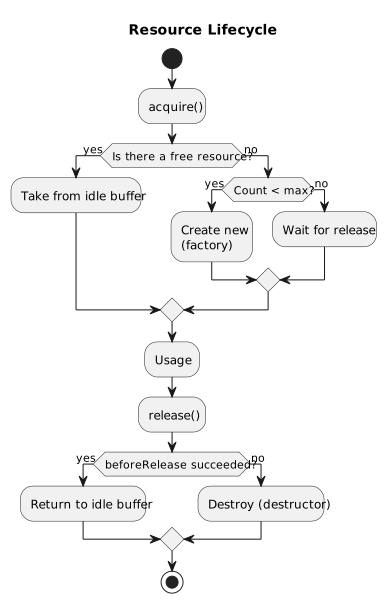
If the pool is full (all resources are in use and max is reached), the coroutine suspends and waits until another coroutine returns a resource. Other coroutines continue running.
On timeout, Async\TimeoutException is thrown, not PoolException. A timeout is not a pool failure: the pool is healthy, it is merely busy, and your own deadline expired. PoolException means the pool itself is unusable (closed, never initialised, factory failed).
Note that TimeoutException extends Exception, not PoolException, so catch (PoolException) will not catch a timeout.
try {
    $resource = $pool->acquire(timeout: 5000);
} catch (Async\TimeoutException $e) {
    // the resource did not free up in 5 seconds -- retry or back off
} catch (Async\PoolException $e) {
    // the pool is closed -- retrying is pointless
}
Non-blocking tryAcquire
$resource = $pool->tryAcquire();

if ($resource === null) {
    echo "All resources are busy, let's try later\n";
} else {
    // Use the resource
    $pool->release($resource);
}
tryAcquire() returns null immediately if a resource is unavailable. The coroutine is not suspended.
Release
$resource = $pool->acquire();

try {
    doWork($resource);
} finally {
    // IMPORTANT: always return the resource to the pool!
    $pool->release($resource);
}
If beforeRelease is set and returns false, the resource is considered damaged and is destroyed instead of being returned to the pool.
Statistics
echo $pool->count();       // Total resources (free + in use)
echo $pool->idleCount();   // Free, ready to be given out
echo $pool->activeCount(); // Currently being used by coroutines
Closing the Pool
$pool->close();On closing:
- All waiting coroutines receive a
PoolException - All free resources are destroyed via
destructor - Busy resources are destroyed upon subsequent
release
Healthcheck: Background Checking
If healthcheckInterval is set, the pool periodically checks free resources. Dead resources are destroyed and replaced with new ones (if the count has dropped below min).
$pool = new Pool(
    factory: fn() => new DatabaseConnection($dsn),
    destructor: fn($conn) => $conn->close(),
    healthcheck: fn($conn) => $conn->ping(),   // Check: is the connection alive?
    min: 3,
    max: 10,
    healthcheckInterval: 10000,                 // Every 10 seconds
);
Healthcheck works only for free resources. Busy resources are not checked.
Circuit Breaker
The pool implements the Circuit Breaker pattern for managing service availability.
Three States
| State | Behavior |
|---|---|
ACTIVE | Everything works, requests go through |
INACTIVE | Service unavailable, acquire() throws an exception |
RECOVERING | Test mode, limited requests |
use Async\CircuitBreakerState;

// Check state
$state = $pool->getState(); // CircuitBreakerState::ACTIVE

// Manual control
$pool->deactivate();  // Switch to INACTIVE
$pool->recover();     // Switch to RECOVERING
$pool->activate();    // Switch to ACTIVE
Automatic Management via Strategy
use Async\CircuitBreakerStrategy;

class MyStrategy implements CircuitBreakerStrategy
{
    private int $failures = 0;
    private int $openedAt = 0;

    public function reportSuccess(mixed $source): void {
        $this->failures = 0;
        $source->activate();
    }

    public function reportFailure(mixed $source, \Throwable $error): void {
        $this->failures++;
        if ($this->failures >= 5) {
            $this->openedAt = time();
            $source->deactivate();
        }
    }

    public function shouldRecover(): bool {
        return time() - $this->openedAt >= 30;
    }
}

$pool->setCircuitBreakerStrategy(new MyStrategy());
The strategy is called automatically:
reportSuccess()-- on successful resource return to the poolreportFailure()-- whenbeforeReleasereturnsfalse(resource is damaged)
Resource Lifecycle
Real-World Example: Redis Connection Pool
use Async\Pool;
use function Async\spawn;
use function Async\await;

$redis = new Pool(
    factory: function() {
        $conn = new Redis();
        $conn->connect('127.0.0.1', 6379);
        return $conn;
    },
    destructor: fn($conn) => $conn->close(),
    healthcheck: fn($conn) => $conn->ping(),
    min: 2,
    max: 20,
    healthcheckInterval: 15000,
);

// 100 coroutines concurrently read from Redis through 20 connections
$coroutines = [];
for ($i = 0; $i < 100; $i++) {
    $coroutines[] = spawn(function() use ($redis, $i) {
        $conn = $redis->acquire(timeout: 3000);
        try {
            return $conn->get("key:$i");
        } finally {
            $redis->release($conn);
        }
    });
}

$results = array_map(fn($c) => await($c), $coroutines);
$redis->close();
PDO Pool
For PDO, there is a built-in integration with Async\Pool that makes pooling completely transparent. Instead of manual acquire/release, the pool is managed automatically behind the scenes.
Learn more: PDO Pool
What's Next?
- Async\Pool Architecture -- internals, diagrams, C API
- PDO Pool -- transparent pool for PDO
- Coroutines -- how coroutines work
- Channels -- data exchange between coroutines